
Cats in Art History: From Ancient Egypt to Lladró's Porcelain Sculptures
Cats have appeared in art for more than 5,000 years, representing everything from divine protection and fertility in Ancient Egypt to independence, mystery and companionship in contemporary culture. Today, brands such as Lladró continue this artistic tradition through handcrafted porcelain sculptures inspired by the enduring symbolism of the feline.

Cat art has evolved over the ages, and have been used in classical styles or more contemporary designs. One modern example is the cat in Lladró's Cosmic Girl and Cat Sculpture which depicts our feline companion in a retro-futuristic decor.
If you need help to find a specific cat figurine or sculpture, contact us for a direct consultation.
A Chronology of Claws: 4 Historical Masterpieces
To understand the historical trajectory of feline fine art, we can trace how various art periods and mediums captured the essence of the cat across four distinct examples:
Tomb Painting, Tomb of Nebamun
Ancient Egypt, circa 1350BC
An unknown Egyptian artist utilized fresco-secco (painting on dry plaster) to depict a gold-furred cat hunting birds. Created during the New Kingdom, this piece reflects a deeply spiritual period where cats were revered as divine protectors and earthly extensions of the gods. Originally worshipped as a fierce, sun-associated lioness, Bastet's image softened over time to that of a graceful domestic cat. She protected families from evil spirits and disease, particularly those affecting women and children.

Can you spot the cat? (Image Source: The British Museum)
Un chat Angola (White Angora Cat), Jean-Jacques Bachelier, 1761
Early Enlightenment Naturalism
Transitioning to 18th-century France, Jean-Jacques Bachelier's White Angora Cat Chasing a Butterfly represents a dramatic pivot toward naturalism. Painted in oil on canvas, this Rococo-era masterpiece captures the luxurious, fluffy texture of an exotic Angora cat with academic precision, mirroring the Enlightenment's growing scientific curiosity about animal anatomy and behavioural biology. Cats in this period are also becoming increasingly common as a domestic pet and a class symbol.

Cats Suggested by the Fifty-Three Stations of the Tōkaidō, Utagawa Kuniyoshi, 1847
Ukiyo-e
In Japan, Utagawa Kuniyoshi revolutionized the ukiyo-e (woodblock print) medium with works like Cats Suggested by the Fifty-Three Stations of the Tōkaidō. Kuniyoshi, a fanatic cat lover, populated his prints with whimsically contorted cats to represent travel checkpoints, cleverly bypassing strict government censorship of human political subjects by substituting expressive, pun-filled felines. In 19th-century Japan, cats symbolized good fortune, political subversion, and supernatural mystery, usually used as a stand-in for humans in art.


Advertisement Poster for Tournée du Chat Noir (The Black Cat Tour), Théophile Steinlen, 1896
Art Nouveau
Finally, Théophile Steinlen’s iconic advertisement for the Parisian cabaret Tournée du Chat Noir showcases the colour lithograph medium at its peak. With its bold, graphic black silhouette, slinky form, and striking yellow eyes, this French Art Nouveau masterpiece permanently transformed the 20th century cat into an avant-garde symbol of bohemian nightlife and counter-culture.
Sculpting the Sacred and the Lucky In Various Cultures


The Maneki-Neko form in two different sculptural form. Baccarat's Maneki-Neko collection (left) uses a typical traditional form but rendering it in clear crystal. Lladró's Maneki-Neko (right) is a more modernistic take with Art-Deco elements of silver lustre ornamentation.
Beyond two-dimensional surfaces, cat sculptures have held immense spiritual, political, and practical relevance across diverse global cultures. The grandest historical example is the Great Sphinx of Giza in ancient Egypt, a monumental limestone sculpture blending a pharaoh's head with a lion’s body to project eternal solar power and royal guardianship. On a smaller, more domestic scale, the traditional Japanese Maneki-neko (beckoning cat) emerged during the Edo period as a ubiquitous ceramic or wooden sculpture designed to invite good fortune, wealth, and welcoming energy into businesses with its raised paw.

Dawon or Somnandi is the tiger mount belonging to Goddesss Durga, representing the tamed unbridled primal energy kept in balance through Durga's mastery of shakti.
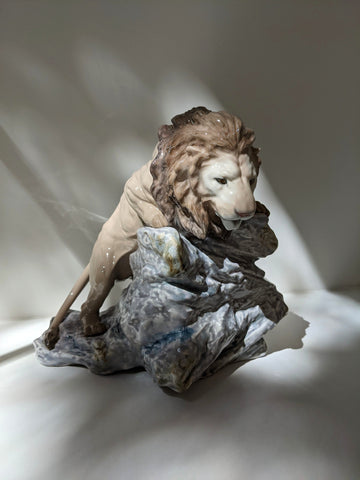
Furthermore, in Pre-Columbian South America, the Moche culture crafted highly sophisticated ceramic effigy vessels shaped like stylized felines, treating these apex predators as sacred bridges to the supernatural realm. Whether massive limestone or handheld clay, sculptural cats have long been deployed as vessels for the protective, the prosperous, and the sacred. Originating in ancient imperial architecture, Chinese guardian lions, traditionally sculpted in powerful pairs of stone or bronze, stand sentinel outside palaces and temples to ward off negative spiritual energy. This symbolic artistic duo features a male lion clutching a globe to signify authority over the realm, balanced by a female protecting a cub to represent the nurturing safekeeping of the home.

Lalique's Zeila Panthers are iconic figures that shows the graceful hunt of the elegant and stealthy large cat. They are available in various colours including clear, pink lustre, black, and gold lustre crystal.
Porcelain Purrfection: The Evolution of Lladró Cats
In the realm of modern collectible art, the legendary Spanish porcelain house Lladró has played a pivotal role in keeping the feline muse alive, showcasing how our relationship with cats can be captured in delicate clay. Emerging from Valencia in the 1950s, Lladró became world-renowned for a highly romanticized, gentle realism. Throughout the mid-to-late 20th century, their feline sculptures adhered strictly to this signature aesthetic. Pieces like Fulgencio Garcia's 1959 Group of Cats and Juan Huerta’s iconic 1984 Cat and Mouse that's still so beloved today featured elongated, graceful forms, executed in soft pastel palettes and finished with a flawless, high-gloss glaze. These mid-century creations focused heavily on the quiet, domestic sentimentality of cats, capturing fleeting, tender moments that are still timeless.


Fulgencio Garcia's 1959 Group of Cats (left) and Juan Huerta’s iconic 1984 Cat and Mouse (right) offers slightly different stylization but focuses the piece on the cat's natural interactive charm.
However, as 21st-century interior design shifted away from traditional porcelain figurines toward bolder, more minimalist aesthetics, Lladró masterfully adapted its approach to feline art. The brand began experimenting with avant-garde forms, replacing the soft pastels and high-gloss glazes with striking matt finishes and monochrome palettes. Modern iterations include stylized, geometric interpretations, such as their Origami Panther collection, and culturally vibrant pieces like the intricately patterned Catrina Cat, which draws from Mexican folk art. By trading quiet sentimentality for sharp, graphic design, Lladró’s evolution mirrors a broader cultural shift: the modern cat is no longer just a soft, sleeping hearthside companion, but a bold, structural design icon fit for a contemporary space.

The Origami Panther collection is one of Lladró's popular collection with a wide variety of colour and finish options. Click here to see the entire range.
Lladró's Cat-alogue
Lladró's extensive cat catalogue features handcrafted porcelain pieces made in their original workshops in Valencia, Spain for almost 75 years. Their specialised artisans complete the entire production process which includes fine texture detailing, facial expression contouring, colouring, flower creation, lustre and enamelling application, and stacking and firing in the kiln. Throughout the decades, Lladró has also created pieces in various styles and from a wide reference to suit a wide range of style and decorative preferences.
If you need assistance with choosing a piece, contact us for a private consultation. At FormFluent, we regularly work with collectors and designers seeking specific and bespoke solutions for various spaces and gifting purposes.
Classic
The classic style features cats in stylised and natural forms, allowing the feline form to freely express their unique charms. Design elements present in these pieces include Lladró's signature pastel colour tones, their handmade flowers made petal by petal, and expressive faces and forms.


Contemporary
The contemporary catalogue provides modern, stylistic, and contemporary design elements like bold or minimalist colours, Art Deco and Art Nouveau features, cultural and pop culture influences, and licensed icons.
Catrina Cat, Little Devil Cat Ltd Ed by Javier Calleja, Cosmic Girl and Cat, Doraemon


Cat Symbolism and Why to Embrace Cat Art
Cats carry rich, multifaceted meanings across culture, folklore, and modern spirituality:
Intuition & Mystery: Because of their nocturnal habits and reflective eyes, cats are widely seen as symbols of inner wisdom, psychic perception, and hidden knowledge. They represent trusting your gut and navigating the unknown.
Independence & Autonomy: Famous for living on their own terms, cats symbolize self-reliance, strong boundaries, and personal freedom. Seeing a cat or cat art often serves as a reminder to honour your own needs, stand in your power, and embrace individuality.
Guardianship & Protection: Tracing back to ancient Egypt (where the goddess Bastet protected homes from evil), cats are believed to absorb negative energy and ward off spiritual harm, acting as quiet protectors of domestic space. This explains why cat art is timeless and still prevails in the modern art scene.
Good Fortune & Prosperity: In Asian traditions, most notably the Japanese Maneki-neko (beckoning cat), cats are symbols of wealth, luck, and thriving business, inviting positive opportunities into the home or workplace. And it doesn't hurt that they are so cute and charming!
Resilience & Rebirth: Popularized by the "nine lives" folklore, cats embody adaptability, survival, and grace under pressure. They symbolize the ability to land on your feet and reinvent yourself after difficult transitions.
For more animal articles:


